لطفا منتظر بمانید ...
0% Complete
English
☰
صفحه اصلی
کنفرانسهای فعال
مدیریت منابع انسانی پایدار
حسابداری
بازاریابی و برندینگ در عصر هوش مصنوعی
هوش مصنوعی:نوآوری، کسبوکار و آموزش
ارشیو کنفرانسها
اولین کنفرانس ملی هوش مصنوعی
دومین کنفرانس ملی هوش مصنوعی
اولین کنگره ملی حسابداری، مالی و مالیاتی
32کنفرانس بین المللی زیست پزشکی
راهنمای شرکت
نحوه ثبتنام
ثبت نام مدیریت منابع انسانی پایدار
ثبت نام دومین کنگره ملی حسابداری
ثبت نام سومین کنفرانس ملی هوش مصنوعی
ثیت نام بازاریابی و برندینگ در عصر هوش مصنوعی
ثبت نام زنجیره ارزش نفت گاز و پتروشیمی
ارسال مقاله
فرمت مقالات مدیریت منابع انسانی پایدار
فرمت مقالات سیستم های هوشمند حسابداری
فرمت مقالات ملی بازاریابی و برندینگ در عصر هوش مصنوعی
فرمت مقالات سومین کنفرانس هوش مصنوعی
سوالات متداول
اخبار و رویدادها
درباره ما
تماس با ما
صفحه اصلی
/
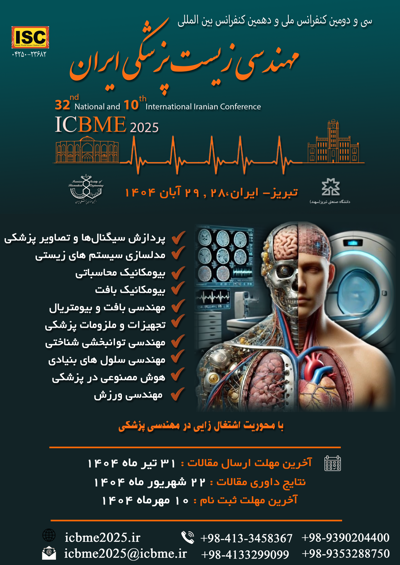
سی و دومین کنفرانس ملی و دهمین کنفرانس بین المللی مهندسی زیست پزشکی ایران
Lightweight 3D U-Net for Robust Liver Segmentation in Multi-Institutional CT Datasets
نویسندگان :
Seyyed Mohammad Hosseini
1
Faeze Salahshour
2
Ahmadreza Sebzari
3
Masoomeh Safaei
4
Hossein Ghadiri Harvani
5
1- دانشگاه علوم پزشکی تهران
2- دانشگاه علوم پزشکی تهران
3- دانشگاه علوم پزشکی بیرجند
4- دانشگاه علوم پزشکی تهران
5- دانشگاه علوم پزشکی تهران
کلمات کلیدی :
Liver،Segmentation،Computed Tomography (CT)،3D U-Net
چکیده :
A computed tomography (CT) image of the liver and surrounding structures provides detailed cross-sectional images, which highlight anatomical variations and pathological conditions. The combination of CT and U-Net networks is a well-known method for liver segmentation, which is vital for accurate diagnosis, treatment planning, and surgical intervention. However, the high computational demands of recent 3D U-Net–based architectures prevent their deployment in resource-constrained environments. A lightweight 3D U-Net optimized for liver segmentation is proposed in this study, maintaining high performance while reducing computational complexity drastically. Several institutional datasets of 250 abdominal CT volumes were compiled from public benchmarks (LiTS, IRCAD) and local clinical sources, encompassing anatomical, pathological, and protocol variations. An isotropic resampling procedure was used to resample, normalize intensity, standardize crops, and augment data on-the-fly. With fewer than two million parameters, the proposed model retains the encoder-decoder and skip-connection designs of conventional 3D U-Nets. An evaluation of a 30% independent set of tests achieved Dice similarity coefficients of 0.85 ± 0.02, intersect-over-unions of 0.82 ± 0.03, inference times under 0.7 s and GPU memory consumption below 2 GB. The performance was consistent across public and local datasets, highlighting the importance of heterogeneous training data. Even though the proposed model is slightly less accurate than heavy architecture, it delivers near-real-time segmentation with minimal resource consumption, so it can be integrated into clinical workflows, especially in environments where computational resources are limited.
لیست مقالات
لیست مقالات بایگانی شده
بررسی تاثیر ارزش ویژه برند بر هوشمند سازی رفتار تبلیغاتی مصرکنندگان موبایل با میانجیگری عشق برند
زهرا علی میرزائی - حسین بوداقی
Patient-Specific TMJ Implants: A Finite Element Study on Placement and Material Effects
Aryana Tavakoulnia - Mohadese Rajaeirad - Nima Jamshidi - Sandipan Roy
پیشبینی وضعیت ترافیک با استفاده از الگوریتم KNN یک مطالعه موردیبر اساس دادههای دوماهه ترافیک
متین نهاوندی
بررسی دیدگاه ها و سیر تاریخی پیرامون حسابداری دارایی های موروثی
فاطمه رفیعی - مهدی ناظمی اردکانی
Simulation and evaluation of the impact of magnetic source geometry on mechanical stress and magnetic flux distribution in cancerous tumors
Alireza Heydari - Mahdi Halabian - Borhan Beigzadeh - Majid Siavashi
Continuous non-invasive blood pressure estimation based on impedance plethysmography measurements
Fatemeh Shokri - Masoomeh Ashoorirad - Rasool Baghbani
Screws That Hold: Stability Analysis of Distal Tibial Fractures Using FEA and a Novel Fixation Index
Amirhossein Karami - Mohadese Rajaeirad - Mohamed Elfekky - Nima Jamshidi
بکارگیری فن آفرینی های پیشرفته جهت شناسایی خانه های خالی با اهداف مالیات گیری
جابر خورشیدسوار - جمال برزگری خانقاه
Finite Element Analysis of Polyoxymethylene Hemostatic Clips: Stress Distribution and Hinge Geometry Optimization
Parastoo Kamali - Hadi Taghizadeh
Region-Specific EEG Channel-Based Emotion Detection using Bi-directional Deep Neural Networks
Mahdi Jafari Asl - Sina Shamekhi - Fatemeh Shalchizadeh
بیشتر
19 اردیبهشت 1405
راهنمای انتخاب کنفرانس معتبر برای چاپ مقاله علمی
19 اردیبهشت 1405
چرا شرکت در کنفرانسهای علمی برای مصاحبه دکتری اهمیت دارد؟
21 اردیبهشت 1405
پذیرش سریع مقاله در کنفرانسهای علمی مهندسی و فناوری آغاز شد
21 اردیبهشت 1405
آغاز ثبتنام در همایشهای بینالمللی مدیریت و حسابداری
ثمین همایش، سامانه مدیریت کنفرانس ها و جشنواره ها - نگارش 44.7.0