لطفا منتظر بمانید ...
0% Complete
English
☰
صفحه اصلی
کنفرانسهای فعال
مدیریت منابع انسانی پایدار
حسابداری
بازاریابی و برندینگ در عصر هوش مصنوعی
هوش مصنوعی:نوآوری، کسبوکار و آموزش
ارشیو کنفرانسها
اولین کنفرانس ملی هوش مصنوعی
دومین کنفرانس ملی هوش مصنوعی
اولین کنگره ملی حسابداری، مالی و مالیاتی
32کنفرانس بین المللی زیست پزشکی
راهنمای شرکت
نحوه ثبتنام
ثبت نام مدیریت منابع انسانی پایدار
ثبت نام دومین کنگره ملی حسابداری
ثبت نام سومین کنفرانس ملی هوش مصنوعی
ثیت نام بازاریابی و برندینگ در عصر هوش مصنوعی
ثبت نام زنجیره ارزش نفت گاز و پتروشیمی
ارسال مقاله
فرمت مقالات مدیریت منابع انسانی پایدار
فرمت مقالات سیستم های هوشمند حسابداری
فرمت مقالات ملی بازاریابی و برندینگ در عصر هوش مصنوعی
فرمت مقالات سومین کنفرانس هوش مصنوعی
سوالات متداول
اخبار و رویدادها
درباره ما
تماس با ما
صفحه اصلی
/
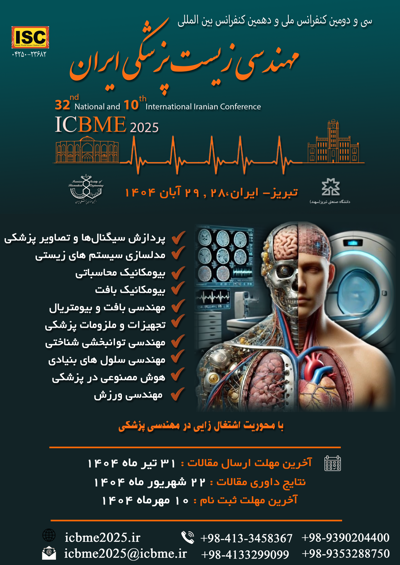
سی و دومین کنفرانس ملی و دهمین کنفرانس بین المللی مهندسی زیست پزشکی ایران
Improving Generalization in MRI-Based Deep Learning Models for Total Knee Replacement Prediction
نویسندگان :
Ehsan Karami
1
Hamid Soltanian-Zadeh
2
1- School of Electrical and Computer Engineering, College of Engineering, University of Tehran Tehran, Iran
2- School of Electrical and Computer Engineering, College of Engineering, University of Tehran Tehran, Iran
کلمات کلیدی :
knee osteoarthritis،deep learning،medical image analysis،MRI،total knee replacement prediction،model generalization
چکیده :
Knee osteoarthritis (KOA) is a common joint disease that causes pain and mobility issues. While MRI-based deep learning models have demonstrated superior performance in predicting total knee replacement (TKR) and disease progression, their generalizability remains challenging, particularly when applied to imaging data from different sources. In this study, we show that replacing batch normalization with instance normalization, using data augmentation, and applying contrastive loss improves generalization. For training and evaluation, we used MRI data from the Osteoarthritis Initiative (OAI) database, considering sagittal fat-suppressed intermediate-weighted turbo spin-echo (FS-IW-TSE) images as the source domain and sagittal fat-suppressed three-dimensional (3D) dual-echo in steady state (DESS) images as the target domain. The results demonstrated a statistically significant improvement in classification metrics across both domains by replacing batch normalization with instance normalization in the baseline model, generating augmented input views using the Global Intensity Non-linear (GIN) augmentation method, and incorporating a supervised contrastive loss alongside the classification loss to align representations of samples with the same label. In the source domain, this approach achieved an accuracy of 74.12 ± 2.90, an F1 score of 74.57 ± 3.33, and a ROC AUC of 80.65 ± 2.83, outperforming the baseline model, which scored 71.29 ± 4.43, 69.76 ± 4.58, and 77.79 ± 4.66, respectively. In the target domain, the method achieved an accuracy of 70.04 ± 2.49, F1 score of 67.30 ± 3.57, and ROC AUC of 78.12 ± 1.97, compared to the baseline’s 52.87 ± 3.17, 18.98 ± 16.89, and 59.33 ± 6.20. The GIN method with contrastive loss performed better than all evaluated single-source domain generalization methods when using 3D instance normalization. Comparing GIN with and without contrastive loss (for both normalization types) showed that adding contrastive loss consistently led to better performance.
لیست مقالات
لیست مقالات بایگانی شده
ارتباط بین کیفیت حسابرسی و مالی سازی شرکت
محمد ملکی
مروری بر توسعه نرمافزار برای دستگاههای اینترنت اشیا
سجاد یوسفی - مریم پورنجف - ایدا اسدی
Freeze-Dried Oxidized Alginate–Gelatin Scaffold Coated with Reduced Graphene Oxide for Bone Tissue Engineering
Mohsen Aghababaei Tafreshi - Sameereh Hashemi-Najafabadi - Nafiseh Baheiraei
نظریه پایداری و ذینفعان: دیدگاه فرآیندی
رعنا شهداور - لیلا مهدیوند - مریم حسن پور
Role of Protective Pads in Mandibular Biomechanics During Frontal Impact
Hosna Olfati - Ata Hashemi
Vision Transformer-Based Emotion Recognition in EEG Using Pseudo-Image Construction
Ali Kouchakzadeh - Soheil Moradi - Mohammad Mohsen Ebrahimi Seyghalan - Mehdi Fardmanesh
حسابداران مدیریت و حسابداری مدیریت استراتژیک نقش فرهنگ سازمانی و سیستمهای اطلاعاتی
حبیب عباس فرمند
تحول دیجیتال: مروری بر ادبیات سیستماتیک و نقش پایداری
رعنا شهدآور - بهزاد صادق تمیز - اکبر حکمت نژاد - یاسر بختیاری
قوانین و مقررات مربوط به هوش مصنوعی: چالشها و فرصتها
محمد جعفری
واحد میکروپلاسما قابلحمل برای بازیافت ضایعات نفتی و تولید انرژی
سید جواد روده چی تبریزی - ثمر گلدوز
بیشتر
19 اردیبهشت 1405
راهنمای انتخاب کنفرانس معتبر برای چاپ مقاله علمی
19 اردیبهشت 1405
چرا شرکت در کنفرانسهای علمی برای مصاحبه دکتری اهمیت دارد؟
21 اردیبهشت 1405
پذیرش سریع مقاله در کنفرانسهای علمی مهندسی و فناوری آغاز شد
21 اردیبهشت 1405
آغاز ثبتنام در همایشهای بینالمللی مدیریت و حسابداری
ثمین همایش، سامانه مدیریت کنفرانس ها و جشنواره ها - نگارش 44.7.0